


Why is sustainability important at Rylock?
Sustainable practices are a business imperative and must be at the core of both strategy and operations with wide-reaching economic, environmental and social implications.
Rylock continuously innovates with respect to both product materials and our manufacturing processes at every possible opportunity to deliver procedures that are consistently refined and products that are sustainably conscious.
Take a deep dive into some common questions regarding sustainable business practices below, and should you still have further questions, then we encourage you to reach out.
Your common sustainability questions answered:
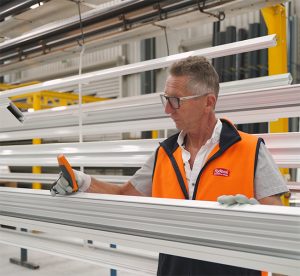
Various materials that make up our products either can be recycled or originate from recycled materials. Some of the glass that goes into our products would be recycled, however, with respect to aluminium and given our product’s requirements for structural integrity, we pride ourselves on using virgin billet from BHP, which is locally mined in Queensland. In 20 to 30 years time, our product would be recycled and smelted for the next product use. Rylock uses finger-joined plantation hardwood for all pre-primed reveals. The product originates from rubberwood plantations in Malaysia, which after the tree completes its latex producing cycle is kiln dried which stabilises the material for construction. This wood is eco-friendly in the sense that it is being used when it would normally otherwise be thrown away.
The overwhelming majority of materials within our products can be recycled. All the glass and aluminium within the product can be recycled/remelted, glass is well known and understood, however, it is worth noting that most of the energy used to produce aluminium is used in the bauxite refinement phase. To remelt/alloy and use refined aluminium is a straightforward process and highly beneficial, (over mining and refining more aluminium).
Our glass is sourced from within Melbourne, (Glassworks, Dandenong South) of which at least 50% is made at Oceania Glass in Dandenong, (the balance has to be imported, on account of its nano-coating of High Performance Low-E coating, (which is highly beneficial from an energy perspective). Our standard product offer is double glazed with the above mentioned High Performance Low-E and Argon Fill gas. All glass is Grade A safety glass, (meaning it is harder to break, and therefore doesn’t require replacement as often, and of course safer if it is broken). We lead the way within our market with this offer, (as the use of annealed glass is still prevalent).
Our manufacturing processes are very efficient, as we have used computers and computer numeric controlled (CNC) equipment to optimise the materials we use in order to minimise wastage. We batch powder coat jobs on a weekly basis in order to reduce waste, and we adhere to very strict water discharge limits, (to our Trade Waste Agreement with South East Water, which are continuously monitored).
From the infancy of a product’s design stage, we consider how an extrusion die will run, to deliver the best material yield. This minimises material wastage and has resulting benefits for the environment. We have over 10 CNC bar preparation machines, and 4 CNC saw centres, now with each cut section that requires further profiling after receiving a barcode that contains all the programmed information for subsequent processes.
As a custom manufacturer of products across a huge array of sizes, we have to ensure offcuts of aluminium and timber are minimised. Again, we rely on our Softech V6 software to do this, (with cutting lists generated to ensure waste is minimised).
15 years ago, we reduced packaging waste significantly with the introduction of reusable steel ‘cradles’ for mill and powder coated metal. This has extended more recently to efficiencies with respect to our ‘L frames’ for finished product storage and delivery. We source 99% of all our aluminium from within Melbourne, (with 1% being ‘legacy dies’ from Auckland, NZ) and this means the energy used in transporting many hundreds of tons of aluminium each year is minimised.